“Us” and “Them”

Exactly. This video captures my passion and expresses my life.

Jesus is not about “us” ministering to “them”, or “us” creating cocoons of shared sensibilities as though we are “Beyond” everyone else.

God help us – institutional and organic churches alike.

Hear me on this: God may not call all of us individually to this or to that, but He does call all His people to a big “us” – also known as His Church, the multifaceted Body of Christ.

And in His Church there is no “them” when it comes to His life being expressed in us, among us and through us.

Continue reading

The Transformational Power of the Cross

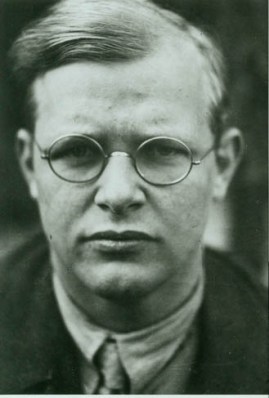
Yesterday was the 123rd anniversary of Hitler’s birth. The fact that we do not celebrate his birth or the evil he did is a testimony to those who gave their lives to stop him.

Dietrich Bonhoeffer

One such man was Dietrich Bonhoeffer, a brilliant theologian and humble pastor who wrote two of the great Christian classics of the twentieth century, The Cost of Discipleship and Life Together.

For Bonhoeffer, his faith was not just a private matter or limited only to the church. As he saw firsthand the horrors of Nazi Germany, he resolved to stop them and became involved in a plot to overthrow the government. The plot failed and Bonhoeffer was arrested. He eventually was martyred by Hitler, who imprisoned him in a German concentration camp and then hanged him.

Continue reading

Sufficient Grace, Part II

As my close friends know, for the last seven years I’ve been dealing with a rare autoimmune condition called scleroderma (also known as systemic sclerosis).

Recent medical tests indicate that it is now impairing my lungs. This is a progressively debilitating and likely fatal development, and there is no known cure. I was not surprised by the latest test results, as I’ve been feeling my health deteriorate more rapidly over the last several months.

I’m posting this to be transparent and so none of my friends feel blindsided. I am totally open about what’s happening, and not bashful over it, so don’t feel you have to ignore it when you’re around me. If you have questions or want to just talk about it, feel free!

However, I also do not want it to define me. My life has been, and will continue to be, about so much more than this disease!

Continue reading

Twitter and Facebook

Twitter and Facebook

Sometimes on Twitter, I just chill:

“Grace, love and mercy are all great, but please, don’t expect too much before I’ve had my morning cup of coffee!”

Other times, I get can’t help it and revert back to my professor days:

“Lord save the West of self-absorbed religion, mired in pietistic post-modern sensibilities, masquerading as Jesus-focused Christianity.”

(Oops. Did I really say that? It just sort of slipped out in an unguarded moment. Me bad!)

Another recent tweet, from my church planting perspective, generated lots of great discussion when re-posted on Facebook:

“Raised country and learned that crap is the best fertilizer. As Jesus brings life from crap, u won’t need no artificial church growth junk.”

(BTW, the crap I’m referring to is the mess in folks lives.)

I love writing this blog, but I also like the more dynamic and interactive environment of Twitter and Facebook.

So how about also connecting on Twitter (OrganicSower) and Facebook (http://www.facebook.com/wright.jim)?

I’ve also added to a new page of recent tweets on my blog, Crossroad Junction.

Join the discussion!

Holy Ghost Church in the County Jail

I spent Sunday afternoon with the guys in one of the churches that we planted three years ago in the local jail.

My voice went hoarse from singing along with them and my fingers became sore from playing the guitar as they took the initiative in starting song after song and leading forth.

For nearly an hour and a half they sang non-stop praises to the Lord, and were so loud and enthusiastic I’m sure they could be heard throughout the building.

They were stompin’, clappin’ and rockin’, with lots of laughin’ and cryin’ in gratitude before the Lord!

Now, I don’t want to shake up anyone’s theology, but the Holy Spirit also was grooving to some powerful, spontaneous rappin’ that was going on!

Continue reading

Outside the Box

For most Christians, “church” is the big box where they attend a “service” on Sunday mornings.

If they are super-committed Christians, maybe it means attending additional meetings and programs that emanate from the Box during the rest of the week.

Outside the Box!

It took me years to learn to think – and act – outside that box!

Yes, Christ can be found in the box. But He does His best work, I’ve found, apart from and outside the box.

My spiritual heritage was outside the box. I was birthed into the Kingdom of God during the Jesus Movement and was very active in what we’d now call a network of “organic” or “simple” fellowships. But as the decades passed, I allowed myself to be slowly but surely drawn into the box.

Getting back out required a fundamental paradigm shift as I honestly and painfully let Scripture strip away my man-made traditions and accumulated expectations.

Continue reading

Modern Day Pauls?

masks

Many tout themselves as apostles and modern-day church planters like Paul, but where’s their Antioch?

Although Paul functioned as an apostolic church planter, his self-expressed credentials included the fact that he continued as an elder – meaning he remained grounded in and part of the local leadership of his home church in Antioch.

All too often we ignore the fact that Paul went on his apostolic missions only after being commissioned and sent by his local church, and that happened only after he’d proven himself over many years in the context of a local, functioning fellowship.

At the end of his various journeys to help start and encourage other churches (except for his last, where history says he was beheaded in Rome), he would then return for a season to his home church in Antioch before being sent out again.

In contrast to Paul, be wary of gifted but itinerant men and women who want to “help” you form or succeed as a local church – through their books, blogs, podcasts, seminars and requests to visit you – yet lack ongoing community with, roots in, commission from, and accountability to another functioning local church.

Some of us have been around long enough to see past incarnations of such floating, unattached “ministries” to local churches.

In the 70’s and 80’s, they proliferated within the Charismatic movement – mainly among those who were certainly gifted but nonetheless could never succeed at finding healthy church with accountable community in their own lives.

Often, they were authors or good aspirational communicators who had exciting ideas, but only answered to themselves.

Sometimes, however, they’d form loose associations where they purportedly answered to each other in lieu of having any Antiochs in their lives – which only tended to reinforce the shared theological and personal idiosyncrasies which attracted them to each other in the first place.

More recently, we saw it in the “organic church” movement, as itinerant “workers” (their euphemism for “apostles”) wreaked havoc on countless house churches. Almost none of those assemblies survived.

Without exception, over time problems emerged with each and every of those so-called apostles and “church planters” – and with the churches that listened to them. (And I mean that – I can’t think of a single one who did not fall prey to one disqualifying problem or another, often related to pride or just becoming increasingly weird!)

There’s too much of this stuff starting to emerge again today, especially among those wanting to be the church one with another. 

Those who promote themselves, their services, and their agendas without living it and having made it first work – with accountable and sustainable results – in their own lives and hometowns are fraught with danger.

Ignore their lack of grounding in an actual, functional church like they promote to others, and you too will reap disaster.

~ Jim Wright

The Great Commission

The Great Commission

The newly touted idea that “ekklesia” (the Greek word translated “church” in the New Testament) and the Great Commission are at odds is itself odd.

Jesus told His disciples:

“All authority in heaven and on earth has been given to me. Go therefore and make disciples of all nations, baptizing them in the name of the Father and of the Son and of the Holy Spirit, teaching them to observe all that I have commanded you. And behold, I am with you always, to the end of the age.” (Matt. 28:18-20 ESV)

The Great Commission applies, according to Jesus’ own words, through the “end of the age”. Any theology or view of “ekklesia” which ignores or somehow discounts that reality – out of reaction to real wrongs like man-centered discipleship or overwhelming external agendas that suck the life out of a church – is fundamentally flawed.

Continue reading

Probation’s Ban on Church Attendance

This is an appeal for help by other churches and ministries in reversing the local probation office’s de facto ban on church attendance in Prince William County, Virginia.

Our network of fellowships, with other churches in the county, actively ministers to and embraces men and women on the fringes of society. We have found that if the Gospel doesn’t work for those whom some consider the worst among us (including ex-sex offenders), then it works for none of us.

Our work with sex offenders often begins in the jail as we reach out to them and they turn their lives over to Jesus. We then engage in intense pastoral counseling that focuses on confession, forgiveness and repentance as we get to the issues in their lives and allow the Lord to bring healing. We also foster indigenous churches in the jail where they, and others, can experience vibrant fellowship and grow in their faith. It is not easy, but we have seen great success.

Continue reading

Celebrating 100 Years of Twisting, Licking and Dunking

Celebrating 100 Years of Twisting, Licking and Dunking

Today is the 100th birthday for Oreo cookies.

I LOVE Oreo cookies! They are proof that God loves us and has a wonderful plan for our lives.

Enjoying an Oreo cookie also theologically demolishes all arguments one may muster in support of a pessimistic, doom and gloom eschatology. Ah, the joy! 

But enough theology …

The great thing about Oreos is that they single-handedly satisfy the FDA’s recommended daily requirements for three of the four essential food groups.

Those four essential food groups are sugar, lard, chocolate and caffeine. To achieve a balanced diet, though, I often have a mug of hot coffee with my Oreos.

I once made the mistake of mentioning our four American food groups to a friend from Canada. He seemed surprised, and said he thought the four major food groups in the U.S. were fast, fried, deep fried and refried.

I told him that was only true in the deep south. In Virginia, by God, we may be south of the Mason-Dixon line, but we’ve managed to hold onto some remnants of high culture!

I must confess, however, that strawberry “fig” newtons are my other weakness. At least they provide some pretense of being healthy (applying snobbish standards), since they contain fruit (that red goo is real fruit, right? – if not, don’t tell me and destroy my ignorant bliss).

Anyway, happy 100th birthday.

Now where did I put my box of Oreos …

~ Jim Wright

Does Jesus Want You to Vote?

I may be a citizen of the Kingdom of God, but the precinct where God has me live and vote is here in Virginia.

Because of my citizenship in Christ’s Kingdom…

Because the Lord rose triumphantly from the grave and declared that “all authority on heaven and earth has been given to me”…

And because of His concurrent command in Matt. 28 to therefore go transform all “nations” (the Greek word is “ethne”, which actually means cultures)…

I take the time to understand the issues and the candidates – and then vote.

Continue reading

Becoming Our Past

Often, longstanding hurts, disappointments and emotional wounds are like old, familiar friends. We let them become so engrained into our sense of identity that they begin to define us.

When that happens, we often aren’t willing to transparently expose and turn them them over to Jesus, but tightly hold onto them like a child clinging to a security blanket.

Instead of finding transformation and wholeness, we become our past.

If this is a struggle for you or someone you know, let me suggest an old blog I wrote years ago called God Shows Up. It’s a good starting point on the road to healing.

Beyond Evangelical? – A Follow Up

Two days after I posted my series “Beyond Evangelical?“, Milt Rodriguez  – who I took to task in my series – wrote a blog which helps close the gap, so to speak, that I was addressing.

I urge everyone to read Milt’s new blog. It really is very good, and is at http://miltrodriguez.wordpress.com/2012/02/24/10-myths-about-organic-church-part-9/.

But the gap still exists so long as he continues to have a very limited view of the “objective” aspect of his “holistic approach” (as he discusses in his blog).

Specifically, does he still discredit, as he’s done in other blogs, those who (to quote him directly) engage in “praying and working toward … bringing this nation back to God” because political and civic engagement “is just another distraction from the person of Christ Himself” (emphasis added)?

Helping the poor and needy – as Milt’s blog urges – is not just doing charity and personal ministry (it certainly can include that, and I’m active in those areas), but also can legitimately include dealing with systemic social and political issues. It also can include those who labor in economics, law, politics, media, the arts, education, and all other spheres of life – not as “distractions” from Jesus but as expressions of the love of Jesus which is alive in them.

I have no idea if God has called Milt to those larger arenas, but my plea is that he expand his vision to embrace those who are called – and rethink some of his very harsh prior rhetoric against other brothers and sisters whose holistic approach may be broader than his own.

As a fellow church planter, I think it is best that we avoid imposing our own gifts, callings and sensibilities (including our political likes and dislikes and maybe our natural tendency to discount those things that we don’t necessarily personally grasp) on God’s people as somehow normative. That is so limiting to those who have God-given abilities and motivations which may exceed or differ from our own.

As I state in my Beyond Evangelical? series, and it bears repeating: Jesus is subjective, personal and relational. But He is also objective, cultural and propositional. And true fellowship – organic, missional, or whatever – must permit folks to express all of Jesus, no matter what our gifts, our callings, or our sensibilities.

Again, though, I think Milt Rodriguez’s latest blog is excellent and I applaud him for it.

Beyond Evangelical? (Part 3)

Post-Modernity

The “You Can’t” Crowd

What I find most bizarre among emerging “Beyond Evangelical” authors is how vocal they are in telling Christians what we can’t do – we can’t be engaged in cultural or civic reform, we can’t go and disciple the nations, we can’t be engaged in politics, we can’t ever take a social position that offends, we can’t this, and we can’t that.

Sometimes, it gets so bad that you can only laugh.

Continue reading

Beyond Evangelical? (Part 2)

Post-Modernity

History Repeats Itself

History demonstrates that a mainly subjective faith is a largely anemic faith, which increasingly becomes insular and irrelevant.

In the 19th century, an overly subjective focus within the Christian community in the West produced an existential form of pietism, which said that everything about anything came down to one thing: a personal relationship with Jesus.

In the 20th century, this came to a more extreme fruition in the existential theology of Karl Barth. Barth concluded that the Bible is not the Word of God, but rather only leads us to the person of Jesus. Furthermore, our subjective experience of Jesus is the only valid authoritative revelation of God’s word. As such, Barth rejected the plenary authority of Scripture as the written Word of God, and it’s role in providing external standards for judging the authenticity of our experience of Jesus.

Continue reading

Beyond Evangelical? (Part 1)

Post-Modernity

The spirit of this age – at least in the West – is post-modernity, which views reality as subjective and truth (if it even exists) as individual and relative.

It is not all bad, but neither is it Christ!

Steeped in a post-modern culture, Western Christians are increasingly re-defining Jesus through post-modern sensibilities that we’ve uncritically inherited from the world.

As a result, we focus on a personal, highly individualistic relationship with Him – which is often driven more by our own needs, our own hurts, and our own insecurities than by Jesus Himself.

Continue reading

True Leadership

Increasing or Decreasing?

Ever notice the strong correlation between how “big” a Christian leader is and the degree of Christian immaturity in “his” organization (i.e., church, ministry, or whatever)?

May we come to grips with the words of John the Baptist, who told his disciples that Jesus “must increase, but I must decrease.”

This is the true measure of leadership in the Body of Christ.

~ Jim

Subscribe

Jesus at the Fringes

It’s amazing how ekklesia takes root in the fringes of society when you empower Christ in existing community rather than trying to bring “church” to them, take them to “church” or do “church” for them.

Why Do We Make It So Complicated?

When some of us started changing our perspective, we started seeing dynamic, participatory, indigenous fellowships emerge in the jail, among the homeless, and with ex-offenders – as well as other improbable existing communities.

The life of Jesus that is evident in those fellowships at the fringes of society is now attracting “normies” to come and be part of their times together. It is amazing to see the spread of the Gospel through those whom society scorns, for the redemption of society.

When you introduce people to the freedom to find and express Christ in them and through them – and thus allow them to relate together as a fully functioning and participatory Body of Christ – Jesus just naturally happens!

Continue reading

We Have Met the Enemy

Losing Our Way

While killing time waiting for an Apple tech to look at my trouble-plagued iPhone, I browsed the racks at an adjacent bookstore.

There was a section for “Philosophy/Humor”.

That was bad enough to make me feel sorrow at our cultural malaise.

But then I saw the section “Faith/Self Help”.

Sigh …

Double sigh …

We have met the enemy, and it is us.

A Multilingual Jesus

A Multilingual Jesus

God speaks to some subjectively, and to others objectively, and each often forgets that Jesus is multilingual. Regardless, His subjective love is rooted in objective truth, and He never limits Himself to just one or the other.

When we become so focused on one, to the exclusion of the other, we are not really relating to a complete Jesus. Rather, we often are seeking self affirmation – a Jesus who simply relates to us on our own terms and within the confines of our own comfort zones.

We need each other in the context of the whole Body of Christ if we truly want Jesus as our wonderful and multifaceted Lord and savior – who then transcends our individual limitations.

As I work with fellowships and minister to individuals, I see that an overly subjective perspective (or, if you prefer, “heart” and feelings) eventually becomes mired in unhealthy sentimentality.

Those, however, who are overly objective (“mind” and logic) eventually become mired in a dry impersonality.

When we together find both the subjective and the objective Jesus, however, we find mature health.

Different Spiritual Languages

Each of us will naturally tend to speak in our own God-given spiritual language of the heart or of the mind, and that’s as it should be. But we nonetheless need each other.

In my own life, God has given me a wonderful wife who relates to God very subjectively. He speaks to her through feelings, while I, on the other hand, hear God very logically and rationally.

When we started dating, we almost didn’t make it because I thought my spiritual language was superior to her’s. I kept insisting that she communicate with me about the Lord in my own language.

She, in turn, couldn’t understand that relating to Jesus through my logic and reason, and my need to figure things out, was just as intensely personal and intimate as her way – even though it was very different.

Where she primarily felt the subjective heart of Jesus, I primarily pursued the objective wonder of Jesus – with very different spiritual languages that matched our different natures.

Several months after we started dating, she broke up with me – through my own fault – because of those differences. But the Lord used our time apart to teach us to honor and value our differences, and to start learning to become bilingual.

For me, it was gut wrenching – literally and figuratively! When the Lord finally allowed me to “figure” out what I had done – by not accepting the validity of how God spoke to her and related to her and thinking my way was superior – I was deeply humbled and I asked her to forgive me. Fortunately, she did!

For the subjective “feelers” among us, though, don’t start cheering because your side won! Trust me, I’ve seen too many instances where insisting that everything is about subjective, relational feelings is just as tyrannical and abusive (often in a seemingly sweet but passive-aggressive way) as insisting that Jesus is only about objective truth. Health and maturity in Christ comes through us learning to hear from, and value, each other.

God speaks things that you need to hear, but won’t hear, except through those who’s spiritual language resonates with His objective nature. Likewise, you will hear things that I won’t hear unless I affirm your subjectivity. And when my objectivity finds unity with your subjectivity, we experience Jesus more fully.

Now that we are married, my wife and I laugh over our very different ways of hearing from, and speaking to, the Lord. But we both know, at the core of our beings, that the other’s spiritual language is just as valid and profound as our own. And when Jesus speaks to my wife via subjective feelings, I listen! Likewise, she listens when Jesus speaks to my logic and reason.

You see, the Lord primarily relates to her in a beautiful language of subjective love and feeling. With me, it is through the wonder of objectively understanding Him and His creation.

Yes, I can be subjective and passionate, but the fact remains that Jesus gave me a very different spiritual language than my wife. And yes, she has logic and reason, but that’s not her primary spiritual language. Yet those differences are fascinating, and we complete each other!

Healthy Communities

Like in a marriage, a healthy community of believers must learn to understand and value each other’s different spiritual languages. Only as we develop the ability to truly hear and appreciate one another, and not be threatened or express impatience towards what often seems so “other” and foreign, will we experience all of Jesus – through each other!

Too often, I fear, we turn “church” into isolated enclaves of sameness, where we retreat into our mutually-affirming comfort zones by seeking to related only to those who speak our own spiritual language.

Only as we affirm the different multilingual voices of God in each of us, is He wholly expressed among all of us.

I thank God that I found this in my marriage, and in a fellowship of diverse brothers and sisters who value the fact that Jesus is multilingual.